Heavy-duty hinges are the core load-bearing components for industrial doors and enclosures. This comprehensive guide provides procurement professionals with everything from definitions to precise selection strategies.
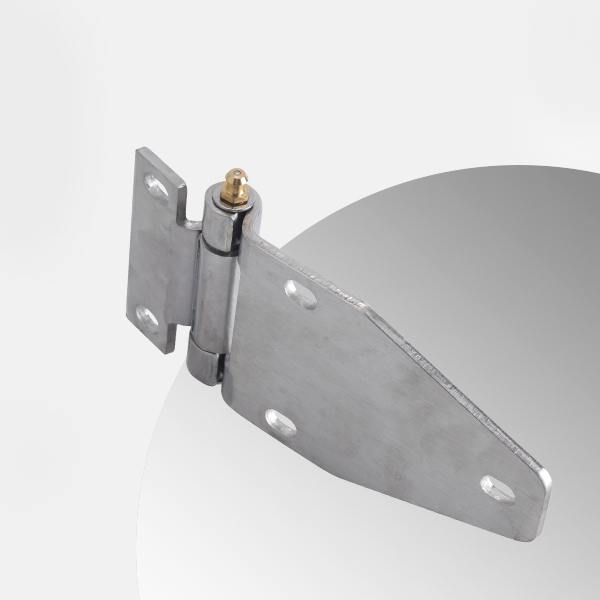
1. Definition and Basic Structure of Heavy-Duty Hinges
What Are They?
These components are specialized industrial hardware engineered to withstand massive weight loads and high-frequency operation. Unlike standard alternatives, they utilize thickened leaves, large-diameter pivot pins, and high-strength materials. A single unit typically has a rated capacity starting at 200 kilograms.
The core structure consists of four parts: the leaf, the pin, the bushing, and the fasteners. The leaf is the metal plate fixed to the door panel and cabinet body, with a thickness of no less than six millimeters. The pin serves as the central load-bearing core connecting the upper and lower leaves, with a diameter ranging from sixteen to twenty-five millimeters.
Three key indicators separate these industrial units from standard hardware: load capacity, fatigue life, and fitting precision. Regular hinges bear 20 to 80 kg, while their robust counterparts start at 200 kg. The operational life also differs dramatically—standard types last 10,000 to 30,000 cycles, whereas these specialized units endure 50,000 to 100,000 cycles.
2. Main Application Scenarios
Industrial cabinet hinges are widely used in power distribution cabinets, server racks, and communication enclosures. The doors on such equipment often weigh between fifty and one hundred fifty kilograms, demanding robust hardware to prevent sagging and protect sensitive internal components over the long term.
Electrical enclosure hinges serve as standard fittings in power infrastructure, installed on high and low-voltage switchgear and transformer cabinets. Power equipment requires exceptional reliability and safety from its hardware. The anti-tamper and anti-loosening designs of these pivots meet the specific demands of the electrical power industry.
Heavy-duty industrial hingesare essential for mining machinery, port equipment, and large press safety guards. In extreme load-bearing scenarios, forged steel super-heavy-duty versions become necessary. A single unit can support 500 to 1,000 kg and deliver a service life exceeding fifteen years.
3. Essential Differences from Standard Hinges
Load capacity represents the most intuitive difference. Standard hardware carries 20 to 80 kg, whereas load-bearing hinges handle over 200 kg. Leaf thickness also varies significantly, from 2-3 mm on ordinary models to 6-10 mm on industrial-grade ones.
Material and heat treatment processes are entirely distinct. Standard hinges typically use Q195 cold-rolled steel without heat treatment. In contrast, specialized units are made from 45# steel or 40Cr alloy steel, undergoing quenching and tempering. The pin hardness exceeds 40 HRC, delivering excellent wear resistance.
Fitting precision and fatigue life differ remarkably. Standard pin-to-bushing clearance measures 0.2 to 0.5 mm. For adjustable hinges in the heavy-duty category, the clearance is tightly controlled between 0.05 and 0.15 mm, maintaining positioning accuracy even after 50,000 cycles.
4. Key Technical Parameters
Load Rating and Safety Factors
Rated capacities for these products are divided into levels of 200 kg, 300 kg, 500 kg, and 800 kg. During selection, apply a safety factor by multiplying the door's total weight by three. For a 100 kg door, choosing a 300 kg class product ensures long-term reliability.
Dynamic load capacity is a critical metric newly emphasized in 2026, required to be at least 70% of the static value. This simulates impact and vibration during operation. Without sufficient dynamic load data, hardware components are prone to premature failure under frequent use.
When installing multiple units, total load capacity should be calculated at 80% of the nominal value. Load distribution between two units requires an uneven coefficient to be considered. The installation spacing should be positioned at one-third and two-thirds of the door panel height.
Material Grades and Heat Treatment
Carbon steel versions are typically manufactured from 45 carbon steel or 40Cr alloy steel, processed through quenching and tempering. The strength after this treatment is more than double that of ordinary carbon steel. The pin undergoes quenching and low-temperature tempering, achieving a surface hardness of 40 to 45 HRC.
Stainless steel hinges are produced using 304 or 316 stainless steel. The 316 grade contains molybdenum, providing significantly stronger resistance to chloride ion corrosion. Coastal chemical plants must choose 316 material to prevent rust deterioration.
Weld-on hinges made from forged steel undergo a high-temperature forging process, resulting in a dense grain structure. The leaf thickness exceeds 8 mm, and a single unit supports over 500 kg. This makes them perfect for extreme scenarios like mining and port operations.
Surface Finishes and Corrosion Resistance
Hot-dip galvanizing provides a layer thickness of no less than 70 microns and withstands over 300 hours of salt spray testing. Powder electrostatic spraying offers a coating thickness of 60 to 100 microns with customizable colors. A 2026 innovation, Zinc-Aluminum-Magnesium coating, resists over 1,000 hours of salt spray exposure.
Stainless steel surfaces undergo passivation to form a dense chromium oxide film. This protective layer can self-repair if damaged, ensuring continuous corrosion resistance. In outdoor environments, these stainless steel units can remain rust-free for over a decade.
Coating adhesion passes inspection if the detachment area in a cross-cut test remains below 5%. Welding joints require separate anti-rust paint application. During procurement, always request the official salt spray test report from the manufacturing facility.
5. Procurement Selection Guidelines
Specification Matching and Dimensions
Start by measuring the mounting hole spacing, leaf length, and pin diameter of your existing hardware. A mismatch in hole spacing makes installation impossible or forces re-drilling. Providing a complete dimensional drawing to the supplier ensures accurate matching.
Confirm the door thickness and material to decide between bolt-on or welded attachment methods. Thin doors suit bolt-on types, while thick doors can be welded or bolted. Adjustable models are ideal for legacy equipment where door frames may have already deformed.
For door panels under two meters high, two units are standard. For heights exceeding 2.5 meters, install three units. In a three-piece setup, the middle unit primarily handles torsional loads. Placement should follow the one-third and two-thirds height rules.
Certifications and Compliance Documents
Exporting to the EU requires CE certification, based on the Machinery and Low Voltage Directives. Exporting to North America demands UL certification, following the UL294 standard for door hardware. The domestic market generally requires compliance with the GB/T 38737 national standard.
Environmental compliance includes RoHS hazardous substance restrictions and REACH chemical registration regulations. Export products must provide both RoHS and REACH testing reports. In 2026, the ISO 14067 carbon footprint certification has also become a requirement.
Before purchasing, obtain a complete set of certification documents and test reports from the manufacturer. The certificates must be valid, and the sample model must match the certificate exactly. Non-compliant hardware risks customs seizure and project bid rejection.
Supplier Evaluation and Sample Testing
Verify the factory's ISO 9001, ISO 14001, and ISO 45001 system certifications. A fully certified factory indicates standardized production management and stable quality output. Suppliers with CNC machining centers and in-house laboratories are naturally more reliable partners.
Before mass procurement, always request samples for installation testing. Load the sample to 1.5 times its nominal value; deformation should not exceed 0.5 millimeters to pass. Conduct a salt spray test based on the operational environmental requirements.
After sample approval, seal the retained sample as the benchmark for batch acceptance. Keep all test reports and physical samples on file. Factories failing sample testing should be eliminated immediately. Building a long-term partnership with a specialized heavy-duty hinge factory helps secure pricing stability and production capacity.
6. Common Procurement Mistakes and How to Avoid Them
Mistake 1: Fixating on Unit Price Over Total Cost
Standard hardware might cost 15 to 30 yuan per unit but often requires replacement every one to two years. By contrast, industrial-grade options range from 80 to 300 yuan yet deliver a service life exceeding a decade. Calculating the five-year total cost reveals the premium choice is actually far more economical.
Labor costs and downtime losses from replacing ordinary hinges far exceed the hardware price itself. In industrial settings, downtime can cost thousands of yuan per hour. The reliability of high-end components prevents unscheduled interruptions and avoids substantial economic losses.
Calculate the entire lifecycle cost rather than fixating solely on the purchase price. The long-term cost-performance advantage of premium hardware components is clear. Ask the supplier for lifecycle data to support your procurement decisions.
Mistake 2: Ignoring Certifications and Test Reports
Uncertified products are cheap but cannot be exported or used in large-scale project bids. Fully certified items meet international standards and enjoy higher market acceptance. Before buying, verify the authenticity and validity period of each certification individually.
If the sample model does not match the certification, it is effectively uncertified. Require the supplier to provide original test reports, and ensure the sample model exactly matches the documentation. The test data must also meet the specific requirements of your usage scenario.
Certification costs are already included in the product price, so there should be no additional fees. Insisting on full compliance is the most basic procurement standard. Even if a non-compliant supplier offers lower prices, proceed with extreme caution.
Mistake 3: Skipping Sample Testing Before Ordering
Sample testing reveals unqualified materials, dimensional deviations, and coating defects. Discovering problems after bulk delivery leads to high processing costs and lengthy delays. Sample testing remains the most cost-effective quality verification method available.
During installation testing, check the load-bearing capacity and the smoothness of rotation. Confirm the mechanism moves freely without sticking. Salt spray tests verify whether the anti-corrosion capability meets environmental requirements. Only proceed with mass purchasing after all tests are passed.
The sample testing cycle usually takes seven to fourteen days, so plan ahead accordingly. Once approved, seal the sample as the final acceptance standard. Suppliers providing unqualified samples should be eliminated immediately to guarantee batch quality consistency.
7.Conclusion
Heavy-duty hinges are core hardware components purpose-built for high-load, high-frequency industrial applications. Their essential characteristics include a leaf thickness of no less than 6 mm, a pin diameter of 16 to 25 mm, and a single-unit load capacity starting at 200 kg.
When procuring these items, evaluate the load rating by selecting at three times the door weight. Pay close attention to the material grade—whether 45# steel, 40Cr alloy, or stainless steel—as well as the surface treatment, such as hot-dip galvanizing or powder coating. Compliance certifications including CE, UL, GB/T, RoHS, and REACH are equally critical.
For distribution cabinets and server racks, prioritize fitting precision and hole spacing when specifying industrial cabinet and electrical enclosure hardware. For extreme environments like mines and ports, specify forged steel variants and rigorously verify the ultimate load data.
Supplier selection must follow a strict four-step process: Qualification Review, Sample Testing, Small Batch Trial, and Mass Procurement. Never skip any stage. By building a long-term partnership with a specialized heavy-duty hinge factory, you secure stable technical support and supply chain reliability, ultimately achieving the best balance between procurement cost and operational quality.