Regular maintenance of industrial heavy-duty hinges can significantly extend their service life. This article shares simple methods for cleaning, lubrication, and inspection of these critical hardware components.
1.Why Maintenance Matters for Industrial Heavy-Duty Hinges
1.1 Why Maintenance Is So Important
Industrial heavy-duty hinges constantly bear door panel loads and endure frequent opening and closing. The pivot shaft and bushing gradually wear over time. Without regular maintenance, the wear rate increases by more than three times. Proper maintenance effectively slows down wear and maintains door panel positioning accuracy.
Dust and oil mix together to form an abrasive compound that accelerates pivot shaft surface wear. Moisture intrusion leads to rust and corrosion, weakening load capacity. Timely cleaning and lubrication prevent these issues from compounding over time.
The cost of maintenance is far lower than the cost of replacing hinges. Each maintenance session takes only 10 to 20 minutes. Four maintenance sessions per year can more than double the service life of industrial heavy-duty hinges.
1.2 Recommended Maintenance Frequency
For indoor dry environments, once per quarter is sufficient. For outdoor humid environments, monthly maintenance is required. For coastal chemical plants, we recommend inspection every three weeks.
For high-frequency opening scenarios (over 100 times per day), shorten the interval to once every two weeks. Industrial heavy-duty hinges with self-lubricating bushings can extend the maintenance cycle to six months. Adjust the maintenance interval flexibly based on actual usage intensity.
Increase maintenance frequency during rainy seasons or high-humidity periods. If unusual noise or binding occurs during opening and closing, perform immediate maintenance. Keeping maintenance records helps track the condition of each hinge.
1.3 Preparation Before Maintenance
Prepare industrial alcohol, cotton cloths, a soft brush, anti-rust grease, and a torque wrench. Industrial alcohol is used to clean oil from the pivot shaft surface. Cotton cloths and soft brushes work together to thoroughly remove debris from hard-to-reach corners.
Wear protective gloves to prevent skin irritation from cleaning agents. Ensure the door panel is closed before performing maintenance. When working at height, use a stable ladder with a spotter.
Test the opening and closing feel before maintenance and record any abnormalities. After closing the door, observe from the gap for obvious sagging. Compare before-and-after differences to verify the effectiveness of maintenance.
2.Cleaning Steps for Industrial Hinges
2.1 Removing Surface Dust
Use a soft brush to sweep away dust from the surface of the hinge leaf and pivot shaft. Brush from top to bottom to prevent dust from falling into the bushing. For stubborn dirt, use a cotton cloth dipped in industrial alcohol and wipe gently.
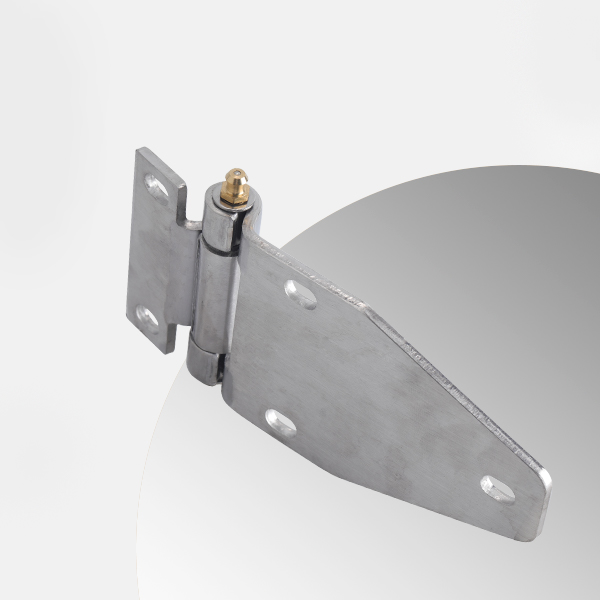
Weld seams and grooves are key areas where dirt accumulates. Use a small brush or cotton swab to reach into gaps and clean them. Welded industrial heavy-duty hinges tend to accumulate oil and grime around the weld area.
After cleaning, wipe the surface dry with a clean cloth to prevent alcohol residue. Ensure the surface is completely dry before proceeding to lubrication. Simple dry-wiping once a week can reduce the need for deep cleaning.
2.2 Deep Cleaning of Pivot Shaft and Bushing
Wrap a cotton cloth dipped in industrial alcohol around the pivot shaft and rotate the door panel back and forth so the cloth rubs the shaft surface. Repeat two to three times until the cloth comes out clean. Black stains indicate a mixture of metal filings and old grease.
Old grease inside the bushing should be removed using a thin stick wrapped with cotton. Insert from one side and pull out from the other side. Incomplete bushing cleaning reduces the effectiveness of new grease.
During cleaning, inspect the pivot shaft surface for scratches or rust spots. Light rust can be gently sanded off with fine sandpaper. Deep rust requires replacement of the pivot shaft or the entire industrial heavy-duty hinge set.
2.3 Rust Treatment Methods
Remove surface rust with a brass brush or fine sandpaper. Sand in the direction of the pivot shaft circumference to avoid transverse scratches. After derusting, immediately apply anti-rust primer to protect the exposed metal.
Rust at weld seams requires cleaning with an electric tool fitted with a wire wheel. After cleaning, apply specialized weld anti-rust paint. Rust at weld seams is a sign of potential structural damage, so inspect carefully for cracks.
If rust depth exceeds 0.3 millimeters, the industrial heavy-duty hinge must be replaced immediately. Continued use poses a serious safety risk. Before replacement, consult the factory to obtain the correct replacement specifications.
3.Lubrication Steps for Industrial Heavy-Duty Hinges
3.1 Selecting the Right Grease Type
For indoor dry environments, choose molybdenum disulfide grease with a temperature range of -30°C to 150°C. For outdoor environments, choose water-resistant lithium grease that does not emulsify when wet. For high-temperature applications (above 150°C), choose synthetic high-temperature grease.
For food processing equipment, choose food-grade grease with NSF H1 certification. Food-grade grease is non-toxic, so occasional leakage does not affect food safety. Ordinary industrial scenarios do not require food-grade products.
Do not use liquid lubricating oil as a substitute for grease. Oil is too fluid and easily runs off, failing to provide long-lasting lubrication inside the bushing. Grease has the right consistency to form a lasting protective film on the pivot shaft surface.
3.2 Controlling the Amount of Grease
The recommended grease amount per hinge is 1 to 2 grams. Excess grease will squeeze out and attract dust, forming sludge that actually accelerates wear.
Use a grease gun or cotton swab to apply grease into the contact gap between the pivot shaft and bushing. After application, cycle the hinge 5 to 10 times to distribute grease evenly. Even distribution is necessary to achieve optimal lubrication.
Wipe away any excess grease that has squeezed out. Keep the leaf surface clean to avoid dust accumulation. For outdoor equipment, allow five minutes for the grease to set after application.
3.3 Post-Lubrication Check
After lubrication, slowly open and close the door panel three times to check for smooth rotation. If there is still a dry feeling, the grease has not fully entered the bushing and needs to be reapplied. Smooth, resistance-free motion indicates proper lubrication.
Use a stethoscope or a screwdriver placed against the hinge to listen to the rotation sound. Proper lubrication produces a uniform, low-pitched sound. The absence of sharp noises confirms good lubrication.
Record the date of each lubrication session and the brand/type of grease used. This helps track the optimal lubrication interval for your specific application. Consult with the factory for grease recommendations suited to your operating conditions.
Inspection Steps for Industrial Heavy-Duty Hinges
4.1 Fastener Torque Inspection
Use a torque wrench to spot-check bolt torque every quarter. Standard torque for M6 bolts is 8 to 10 Newton-meters. For M8 bolts, it is 15 to 20 Newton-meters. Bolts below 80 percent of the standard value need retightening.
Before retightening, apply medium-strength thread-locking compound to the threads. This effectively prevents loosening from vibration. After tightening, check whether the marked alignment lines on bolt heads are still aligned.
If a bolt repeatedly loosens, check whether the threads are stripped. Stripped threads require repair with a threaded insert or replacement with a larger diameter bolt. Welded industrial heavy-duty hinges do not require this check but do require weld inspection.
4.2 Gap and Wear Measurement
With the door panel opened to 30 degrees, shake it up and down. Looseness exceeding 2 millimeters indicates excessive clearance. Use a vernier caliper to measure the pivot shaft diameter. Replacement is required if the diameter has reduced by 0.5 millimeters compared to original specifications. When bushing clearance exceeds 0.3 millimeters, the industrial heavy-duty hinge no longer provides adequate load capacity.
Leaf thickness measurements that are more than 20 percent below the initial value require replacement. If the gap difference increases for two consecutive measurements, wear is accelerating. Record wear data to determine whether the maintenance interval is appropriate.
For industrial heavy-duty hinges with self-lubricating bushings, check the remaining bushing depth. Prepare replacement parts when the remaining bushing thickness drops below 1 millimeter. Early procurement prevents emergency shutdowns.
4.3 Replacement Criteria
Replacement is required when any of the following conditions are met: pivot shaft diameter wear exceeds 0.5 millimeters; bushing clearance exceeds 0.3 millimeters; visible cracks or permanent deformation appear in the leaf; weld cracks exceed 5 millimeters; rust depth exceeds 0.3 millimeters and cannot be removed.
When replacing, choose a product of equal or higher specifications. Before replacement, confirm with the factory whether the mounting hole spacing matches. Record the failure cause of the old hinge to improve future selection and maintenance practices.
Timely replacement is the final barrier to ensuring safety. Maintain communication with the factory to access the latest replacement recommendations and technical support.
5.Summary: Easy 3-Step Maintenance for Industrial Heavy-Duty Hinges
Easy maintenance of industrial heavy-duty hinges requires only three core steps: cleaning, lubrication, and inspection. Investing a small amount of time each quarter yields significant results.
During cleaning, use a soft brush and industrial alcohol to thoroughly remove oil and rust from the pivot shaft and bushing. Ensure the surface is clean before proceeding to lubrication.
During lubrication, select molybdenum disulfide grease (indoor) or water-resistant lithium grease (outdoor) based on the operating environment. Apply 1 to 2 grams per hinge and cycle several times to distribute grease evenly.
During inspection, use a torque wrench to retighten fasteners and use a vernier caliper to measure pivot shaft wear and bushing clearance. Record data to track changes over time.
The maintenance procedures for cabinet hinges and heavy-duty industrial hinges are essentially the same as the steps described above.
Maintain communication with a professional industrial hinge manufacturer to obtain maintenance recommendations and grease selections tailored to your specific operating conditions.
Consistent regular maintenance can extend the service life of industrial heavy-duty hinges from the standard five years to more than ten years, while also preventing downtime losses and safety risks caused by sudden failures.