Views:0 Author: Dele-Heavy-Duty Industrial Hinge Manufacturers Publish Time:2026-06-24 Origin:Dele-Industrial cabinet lock manufacturer
This article provides a detailed analysis of heavy-duty hinge load capacity ranges, offering precise load data references from three aspects: material, specification, and application scenarios.
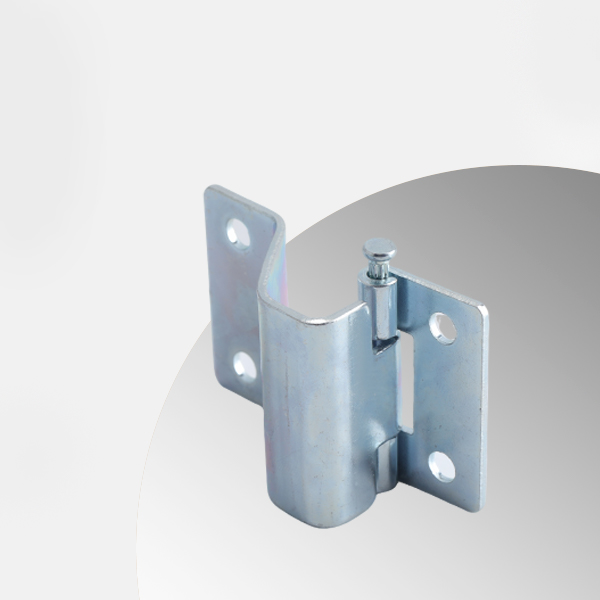
Standard heavy-duty hinges on the market typically support between 100 kilograms and 300 kilograms per hinge.
This is the baseline load range for most industrial cabinets, distribution boxes, and machinery access doors.
Products below 100 kilograms should be classified as medium-duty hinges and are not suitable for heavy-duty applications.
A single-hinge load of 150 kilograms is the threshold value for heavy-duty hinges.
Below this value, they are not recommended for load-bearing door panels.
Standard heavy-duty hinges use 4 to 6 millimeter leaf thickness and 10 to 16 millimeter pivot shaft diameters.
This heavy-duty hinge specification meets the daily operational requirements of most industrial cabinets.
For standard 19-inch server cabinets, two 120-kilogram rated heavy-duty hinges per door are sufficient.
However, if the door panel has additional loads such as heat sinks or displays, load requirements must be increased accordingly.
For port equipment, mining machinery, and large press protective covers, specially made heavy-duty hinges can achieve load capacities of 500 to 1,000 kilograms.
This type of heavy-duty hinge uses leaf thickness above 8 millimeters and pivot shaft diameters of 20 to 25 millimeters.
Some custom products can even achieve a single-hinge ultimate load of 1,500 kilograms.
Ultra-heavy-duty hinges typically use forged steel and dual-pivot shaft designs.
Forged steel heavy-duty hinges achieve a yield strength of over 600 MPa, far exceeding that of ordinary carbon steel products.
In actual testing, high-quality ultra-heavy industrial hinges maintain integrity at 1.5 times the rated load.
Ultra-heavy industrial hinges are indispensable in heavy industry, but cost five to ten times more than standard products.
Before purchase, accurately calculate the total door panel weight to avoid overspecification and waste.
Mining and port equipment commonly use ultra-heavy-duty industrial hinges.
Some small equipment is marketed as an industrial hinge but offers only 50 to 80 kilograms of load capacity.
These products mainly suit light-load scenarios such as instrument cabinets and communication enclosures.
Strictly speaking, these belong to the medium-duty hinge category.
When purchasing, carefully verify load parameters.
50 to 80 kilogram industrial hinges typically use 3 millimeter leaf thickness and 8 millimeter pivot shaft diameters.
They are lower in cost but not recommended for safety-related access doors.
When selecting an industrial hinge, always confirm whether the rated load is static or dynamic.
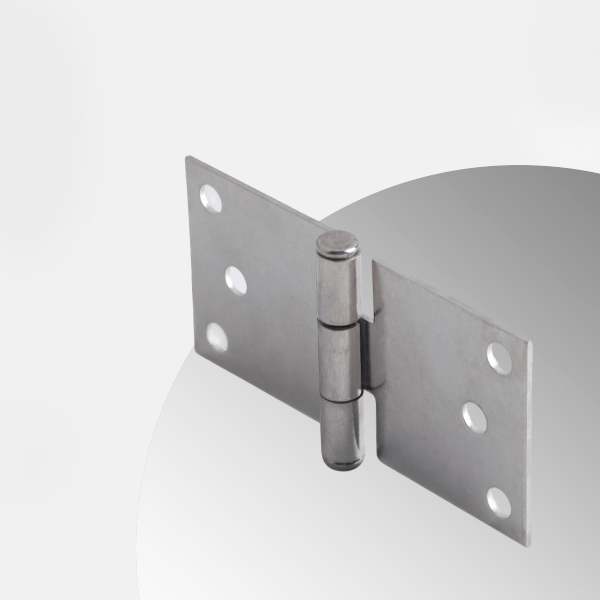
Under the same specifications, forged steel heavy-duty hinges offer 1.5 to 2 times the load capacity of carbon steel hinges.
304 stainless steel industrial hinges have slightly lower load capacity than carbon steel, approximately 10 to 15 percent less.
316 stainless steel, with added molybdenum, offers slightly higher strength than 304.
Forged steel industrial hinges achieve tensile strength above 800 MPa after quenching and tempering.
Carbon steel industrial hinges have tensile strength of approximately 400 to 500 MPa.
When selecting a heavy-duty hinge, material directly determines the maximum load capacity for a given volume.
In corrosive environments, stainless steel industrial hinges offer slightly lower load capacity but longer service life.
Considering the total lifecycle, stainless steel industrial hinges often provide better value.
Cabinet hinges in outdoor applications frequently use stainless steel to balance load capacity and corrosion protection.
For every 2 millimeter increase in leaf thickness, the heavy-duty hinge load capacity increases by approximately 40 percent.
A 4 millimeter leaf supports approximately 150 kilograms, 6 millimeters reaches 250 kilograms.
Industrial hinges with leaf thickness above 8 millimeters can exceed 400 kilograms load capacity.
Pivot shaft diameter has an even more significant impact on load capacity.
Increasing diameter from 10 millimeters to 16 millimeters nearly doubles load capacity.
A heavy-duty hinge with a 16 mm pivot shaft can withstand a load of 500 kilograms.
The fit clearance between pivot shaft and bushing should be controlled within 0.1 millimeters.
Pivot shaft material also affects load capacity, with quenched shafts offering higher hardness.
High-quality load-bearing hinges use 40Cr or 42CrMo alloy steel for pivot shafts.
When selecting an industrial hinge, request hardness reports for the pivot shaft material from the manufacturer.
Welded industrial hinges typically offer 10 percent higher load capacity than bolted types.
This is because welding eliminates stress concentration points at hole positions, resulting in more uniform force distribution.
However, welded heavy-duty hinges cannot have their position adjusted after installation, requiring extremely high positioning accuracy.
Bolted industrial hinges have load capacity limited by fastener strength and hole position accuracy.
Using Grade 8.8 high-strength bolts can improve load capacity by approximately 15 percent.
Removable industrial hinges have 10 to 15 percent lower load capacity than welded types.
In actual installation, the combined load capacity of two heavy-duty hinges is not simply the sum of their individual ratings.
We recommend calculating total load capacity at 80 percent of the single-hinge rating.
Door panel deformation and installation errors reduce the actual effective load capacity of industrial hinges.
Indoor standard power distribution cabinet door panels typically do not exceed 50 kilograms.
Selecting a 100-kilogram rated heavy-duty hinge is sufficient.
Server cabinet fully loaded door panels can reach 60 to 80 kilograms.
We recommend selecting a 160-kilogram rated heavy-duty hinge.
Console and control panel doors are typically lighter, with 80 kilograms sufficient.
To handle unexpected impacts, we recommend a safety factor of 2 for indoor heavy-duty hinge selection.
For example, a 50-kilogram door panel requires a heavy-duty hinge rated above 100 kilograms.
Indoor environments have no corrosion concerns, making carbon steel industrial hinges the most cost-effective choice.
High-frequency opening cabinets (over 50 times per day) should use heavy-duty hinges with self-lubricating bushings.
Wear gradually reduces the actual load capacity of heavy-duty hinges.
Regular maintenance keeps industrial hinges operating within the designed load range for long-term operation.
Outdoor communication base station cabinet doors weigh approximately 40 to 60 kilograms.
A 150-kilogram rated stainless steel heavy-duty hinge is required.
Charging station door panels are subjected to repeated pulling by users.
We recommend selecting a 200-kilogram rated heavy-duty hinge.
Coastal outdoor equipment should prioritize 316 stainless steel material.
Outdoor heavy-duty hinges require additional consideration of wind loads and snow loads.
We recommend increasing the safety factor to 2.5 times.
Ordinary carbon steel heavy-duty hinges experience significant load capacity degradation outdoors due to corrosion.
Stainless steel industrial hinges offer slightly lower load capacity outdoors but far superior durability than carbon steel.
For extreme temperature environments (minus 40°C to +60°C), forged steel load-bearing hinges are more reliable.
At low temperatures, ordinary steel becomes brittle, and load capacity decreases significantly.
Heavy-duty industrial hinges in outdoor extreme conditions must be selected to the highest standards.
Mining machinery access doors can weigh 150 to 300 kilograms.
A 500-kilogram rated heavy-duty hinge is required.
Port crane inspection doors are subjected to impact loads.
We recommend selecting an 800-kilogram rated forged steel heavy-duty hinge.
Large press protective covers must use 1,000-kilogram ultra-heavy heavy-duty hinges.
In heavy industrial scenarios, dynamic impact loads far exceed static door panel weight.
We recommend a safety factor of 3 to 4 times.
The ultimate load capacity of forged steel heavy-duty hinges offers clear advantages in such scenarios.
When a single heavy-duty hinge lacks sufficient load capacity, use 3 to 4 hinges to distribute loads equally.
Heavy industrial heavy-duty hinges should undergo load capacity testing every six months.
Inspect for load capacity degradation caused by wear and replace the hinges promptly.
Choose a heavy-duty hinge manufacturer with extensive heavy industry experience for custom solutions.
Reputable heavy-duty hinge manufacturers should provide test reports from accredited laboratories.
Reports must include static load testing at 1.5 times rated load held for one minute.
The report should also include durability testing data for 50,000 cycles at the rated load.
Test reports should clearly specify temperature, humidity, and loading speed conditions during testing.
These environmental factors affect the actual load performance of heavy-duty hinges.
Users should verify whether the sample specifications in the report match the purchased product.
Request salt spray test reports to evaluate corrosion's long-term impact on load capacity.
500 hours of salt spray testing roughly corresponds to 2 years of outdoor use.
Corrosive environments cause heavy-duty hinge load capacity to decay by 5 to 10 percent per year.
On-site, use progressive load addition to verify heavy-duty hinge load capacity.
Open the door panel to horizontal position and gradually add weights to 80 percent of the rated value.
Observe whether visible deformation or unusual noise occurs at the heavy-duty hinge leaf-to-cabinet connection.
Use a feeler gauge to measure changes in the four-side gap when the door panel is closed.
A gap difference exceeding 2 millimeters indicates insufficient load capacity or deformation of the heavy-duty hinge.
Regular testing helps monitor the load capacity degradation trend of heavy-duty hinges.
Check by hand whether opening and closing feel shows binding or looseness.
Binding may indicate pivot shaft deformation, while looseness indicates bushing wear.
Both conditions indicate that the hinge's actual load capacity has decreased.
If problems are found, contact the heavy-duty hinge manufacturer promptly for professional inspection.
The load capacity of heavy-duty hinges has no single fixed value but varies across a wide range based on material, specification, and installation method.
Standard heavy-duty hinges offer single-hinge load capacity of 100 to 300 kilograms.
This is sufficient for most industrial cabinets and distribution boxes.
Ultra-heavy products can achieve 500 to 1,000 kilograms, suitable for extreme heavy-load scenarios such as mines and ports.
When selecting, comprehensive consideration must be given to door panel weight, dynamic impact loads, safety factor, and operating environment.
In terms of material, forged steel offers the highest strength, stainless steel offers slightly lower strength but superior corrosion protection, and carbon steel offers the best cost performance.
In actual installation, reserve a 20 percent margin and calculate total load capacity at 80 percent of single-hinge rating.
Cabinet hinges and heavy-duty industrial hinges follow the same selection principles described above.
Concealed hinges require special attention to load capacity verification due to limited space for reinforcement.
Correct load calculation and selection allow heavy-duty hinges to achieve a safe service life exceeding ten years.
This also effectively prevents door panel sagging and accidental door failures.
Previous:Which Heavy-Duty Hinge Material Is Most Durable?
Next:No More!