Selecting heavy-duty hinges for gates requires careful consideration of load capacity, material, and installation method. This article compares three mainstream types to help you find the best match for your needs.
1. Core Selection Factors for Gate Heavy-Duty Hinges
1.1 Load Capacity Is the Primary Indicator
Gates are typically heavier than standard cabinet doors, with single-leaf panels weighing between 100 and 300 kilograms. When selecting industrial hinges, the single-hinge load capacity must reach three times the door panel's own weight. For a 200-kilogram door panel, choose a 600-kilogram rated product to ensure long-term sag-free performance.
Dynamic load is equally critical. Wind loads on gates during storms can exceed the door's own weight. Dynamic load data should be no less than 1.5 times the static load. Request dynamic test reports from the heavy-duty hinges factory to confirm compliance.
For high-frequency opening scenarios (over 50 times per day), pay extra attention to fatigue life. 50,000 opening cycles is the minimum threshold for quality products. Gates typically have a service life of over ten years, so selection should include ample margin.
1.2 Material Selection Determines Service Life
Carbon steel products are low-cost and suitable for indoor dry environments. Carbon steel offers high strength but requires anti-rust coating protection. Once the coating is damaged, rusting occurs easily. Hot-dip galvanized carbon steel products can achieve 300 hours in salt spray testing.
Stainless steel products offer excellent corrosion resistance, making them suitable for outdoor gates and coastal areas. 304 stainless steel achieves over 500 hours in salt spray testing, while 316 stainless steel can reach 1,000 hours. Stainless steel requires no additional coating and has low maintenance costs.
Forged steel products offer the highest strength, suitable for heavy industrial gates and blast-proof doors. Forged steel leaves are 8 millimeters or thicker, with pivot shaft diameters of 25 millimeters. The single-hinge load capacity can exceed 1,000 kg, though the price is three to five times that of carbon steel.
1.3 Choosing the Installation Method
Welded products are the best choice for gates with high anti-theft requirements. After welding, there are no removable external parts, providing excellent pry resistance. Position cannot be adjusted after installation, so precise gap calibration is required before welding.
Bolted products are suitable for gates requiring regular maintenance. Bolts can be retightened when loose, making maintenance convenient. Use high-strength bolts with thread-locking compound to prevent loosening from vibration.
Removable (plug-in) types are suitable for gates requiring frequent door panel removal. The door panel can be lifted upward and removed directly, convenient for cleaning and inspection. Load capacity is 10 to 15 percent lower than welded types, so allow extra margin during selection.
2. Three Most Common Gate Heavy-Duty Hinges Compared
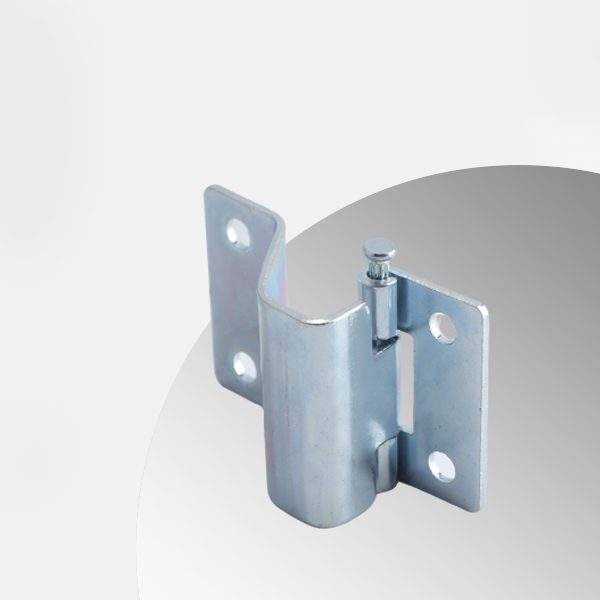
Reinforced Welded Type
6mm leaf, 20mm shaft, 300-500kg capacity. Best sag resistance. Permanent installation. Ideal for factory and warehouse gates.
Adjustable Eccentric Type
±3mm adjustment. No-disassembly fine-tuning. Ideal for retrofits and gates in areas with ground settlement.
Stainless Steel Self-Lubricating
304SS + bronze bushing. 500h+ salt spray. Zero maintenance. Best for coastal villas and food processing plants.
2.1 Reinforced Welded Gate Heavy-Duty Hinges
Reinforced welded hinges feature 6-millimeter leaves and 20-millimeter pivot shafts, with single-hinge load capacity of 300 to 500 kilograms. Multiple reinforcing ribs on the leaf provide bending rigidity far exceeding standard products. Welding eliminates stress concentration at hole positions, ensuring stable load capacity.
Full-penetration welds are free of porosity, with the heat-affected zone minimized. Welded types have no bolt loosening risk, maintaining stable clearance during long-term use. Sag resistance ranks first among the three hinge types.
Cost is moderate with outstanding durability, suitable for factory doors and warehouse sliding gates. Position cannot be adjusted after installation, requiring high positioning accuracy. The heavy-duty hinges factory provides welding positioning templates to reduce installation errors.
2.2 Adjustable Eccentric Gate Heavy-Duty Hinges
Adjustable eccentric hinges feature adjustment screws for fine-tuning door panel position vertically and horizontally. Adjustment range is 3 millimeters front-to-back, 2 millimeters left-to-right, and 2 millimeters up-and-down. Minor sag can be corrected without disassembly.
The eccentric adjustment mechanism is hardened to prevent failure under repeated use. Lock nuts prevent position changes after adjustment. Debugging time is reduced by half compared to standard types, with outstanding maintenance convenience.
Cost is 20 to 40 percent higher than standard types, suitable for gates requiring frequent adjustments. Widely used in retrofitting old door frames. After adjustment, record the setting positions for quick recovery later.
2.3 Stainless Steel Self-Lubricating Gate Heavy-Duty Hinges
Stainless steel self-lubricating hinges combine 304 stainless steel with a bronze bushing. The bronze bushing has a low friction coefficient of 0.08, with wear rate one-third that of steel-on-steel contact. Salt spray testing exceeds 500 hours.
The self-lubricating feature eliminates the need for frequent greasing, maintaining long-term rotational precision. The silver-white metallic luster makes it suitable for gates with aesthetic requirements. Ten years of rust-free performance keeps appearance like new.
Initial cost is the highest, but total lifecycle cost is the lowest. Suitable for coastal villa gates, chemical plant entrances, and food processing plant doors. Comprehensive service life exceeds 15 years, making it the most economical choice long-term.
3. Recommended Heavy-Duty Hinges for Different Gate Types
3.1 Selection for Entry Gates
Villa entry gates are typically solid steel, weighing approximately 150 to 200 kilograms. We recommend stainless steel self-lubricating products, which balance load capacity, corrosion resistance, and aesthetics. 304 stainless steel with a bronze bushing ensures ten years of rust-free, noise-free operation.
Install two hinges with spacing at one-third and two-thirds of the door panel height. Single-hinge load capacity should not be less than 300 kilograms. Use the bolted type for convenient future maintenance.
For gates with high appearance requirements, choose concealed installation industrial hinges. Only the pivot shaft is visible externally, providing a clean overall look. Concealed installation requires grooving inside the door frame and panel, which is more difficult to install.
3.2 Selection for Industrial Factory Gates
Industrial factory gates are wide and heavy, with door weights ranging from 300 to 500 kilograms. Reinforced welded products offer the best cost-performance ratio. Six-millimeter leaves with 20-millimeter pivot shafts provide single-hinge load capacity above 500 kilograms.
Install three hinges for added stability,with the middle hinge bearing the
torsion load. Welded types eliminate bolt loosening risk, maintaining stable
clearance during long-term use. Use positioning templates during installation to
ensure all three hinges are vertically aligned
For outdoor factory environments, choose hot-dip galvanized or powder-coated products. Coating protection combined with regular touch-up painting can achieve ten years of service life. Confirm weld anti-rust treatment processes with the heavy-duty hinges factory.
3.3 Selection for Outdoor Garden Gates
Garden gates are typically made of wrought iron or aluminum, weighing approximately 80 to 150 kilograms. Adjustable eccentric products are ideal, easily accommodating door frame deformation caused by ground settlement. Adjustment screws allow easy correction of door panel position.
Choose 304 stainless steel material to prevent rust from sun and rain exposure. Bronze bushings reduce friction loss and maintain smooth operation. Fine-tune position every two to three years, eliminating frequent maintenance hassles.
Garden gates have relatively low opening frequency, so the highest load capacity is not required. A safety factor of 2.5 times is sufficient. For door panels exceeding 2.5 meters in height, install three hinges for enhanced stability.
4. Installation and Maintenance Key Points for Gate Heavy-Duty Hinges
4.1 Precise Installation Ensures Long-Term Stability
Before installation, use a laser level to establish the vertical mounting line. Verticality error between upper and lower hinges should not exceed 1 millimeter. Excessive error causes inconsistent gaps when the door panel is closed.
Pre-drill hole diameter should be 0.5 millimeters smaller than the bolt diameter to ensure tight thread engagement. Thread bolts in by hand to confirm alignment, then tighten with a torque wrench to standard values. M8 bolts require 15 to 20 Newton-meters, using a diagonal cross-tightening sequence.
For welded hinges, tack weld in position first, test opening and closing, then complete the full weld. Use a segmented welding method for the full weld, with each segment not exceeding 30 millimeters. Alternate welding on both sides to prevent thermal deformation. After welding, remove slag and apply anti-rust paint.
4.2 Regular Inspection and Maintenance
Check bolt torque quarterly and retighten if below 80 percent of standard value. For welded hinges, inspect welds for cracks or rust. Address any abnormalities promptly with re-welding or paint touch-up.
Apply anti-rust grease to the pivot shaft every six months. For outdoor gates, use water-resistant lithium grease. For indoor use, use molybdenum disulfide grease. After application, cycle the hinge 10 times to distribute grease evenly.
Measure door panel gap differences annually and compare with installation baseline data. Consecutive gap increases indicate accelerating hinge wear. Replace promptly if wear exceeds limits to prevent door panel falls.
4.3 Replacement Criteria and Procurement Recommendations
Replacement is required when: pivot shaft diameter wear exceeds 0.5 millimeters; bushing clearance exceeds 0.3 millimeters; leaves develop cracks or permanent deformation.
When replacing, choose products of equal or higher specifications. Ensure new hinge mounting hole spacing matches the original product to avoid re-drilling. Order spare parts in advance from the heavy-duty hinges factory to minimize downtime.
After replacement, re-debug door panel position and record baseline data. Analyze the failure cause of old hinges to improve future selection. Correct installation and maintenance ensure gate hinges operate safely for over ten years.
5. Summary: Selecting the Right Heavy-Duty Hinges for Your Gate
Selecting heavy-duty hinges for gates requires comprehensive consideration of load capacity, material, installation method, and maintenance convenience.
Reinforced welded hinges offer 300 to 500 kilograms load capacity and are ideal for industrial factory gates with high anti-theft requirements.
Adjustable eccentric hinges provide up to 3 millimeters adjustment range and are suitable for garden gates in areas prone to ground settlement.
Stainless steel self-lubricating hinges offer corrosion resistance and maintenance-free operation, ideal for coastal villa gates and food processing plant entrances.
The core selection principle is that single-hinge load capacity should be no less than three times the door panel weight. Installation spacing should be controlled at one-third and two-thirds of the door panel height.
For material selection, choose carbon steel for indoor use, 304 stainless steel for outdoor use, and forged steel for extreme heavy-load applications.
Maintain communication with a professional heavy-duty hinges factory. Provide detailed information about gate weight, opening frequency, and environmental conditions to receive accurate selection recommendations.
Correct selection combined with quarterly inspections and semi-annual lubrication ensures gate hinges operate safely for more than ten years.