Views:104 Author: Dele-Heavy-Duty Industrial Hinge Manufacturers Publish Time:2026-05-27 Origin:Dele-Industrial cabinet lock manufacturer
This article provides an in-depth performance comparison of various Industrial Enclosure Hinge, recommending high-quality heavy-duty industrial hinges and stainless steel cabinet hinges to help you select the most durable Industrial Enclosure Hinge for your needs.
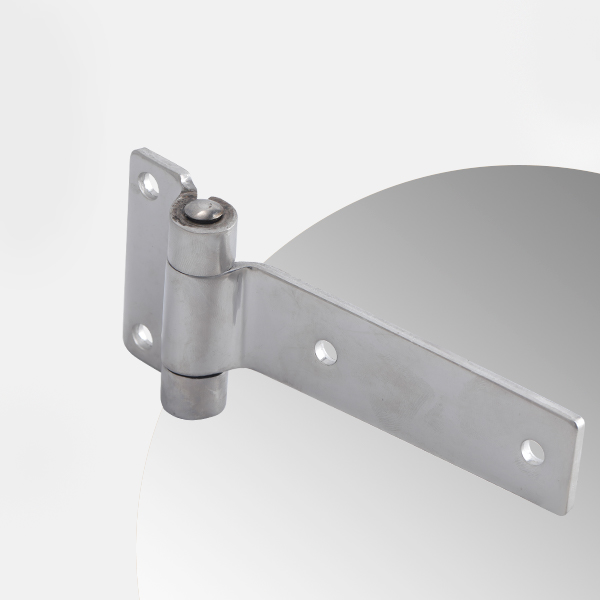
A good Industrial Enclosure Hinge should first have a load margin that exceeds twice the fully loaded weight of the cabinet. Typically, a high-quality stainless steel cabinet hinge achieves a static load capacity of over 150 kilograms.
At the same time, the opening and closing cycle test count should not be less than 100,000 times. This is the gold standard for measuring the wear resistance of heavy-duty industrial hinges. Ignoring this parameter may cause the door panel to sag after only six months of frequent use.
For humid or outdoor environments, Cold-rolled steel of 3.0 millimeters or thicker, with an electrophoretic coating, represents the basic requirement. For coastal chemical plants, three-series stainless steel cabinet hinges are mandatory.
Additionally, the pivot pin of industrial door hinges should include self-lubricating washers to prevent rust-seized hinges from forcing operation and damaging the cabinet. For surface treatment, zinc plating or electroless nickel plating is recommended, with salt spray testing should reach at least 96 hours..
This model is the top choice for outdoor communication cabinets. The housing uses one-piece cast 304 stainless steel, combined with double sealing rings to achieve an IP68 protection rating.
This Industrial Enclosure Hinge effectively blocks moisture from entering the pivot shaft. When used with industrial door hinges of the same material, it resists highly corrosive gas erosion. Recommended for wastewater treatment plants or seaside base stations.
For large power distribution cabinets or server racks, this type of heavy-duty industrial hinge features four reinforcing ribs on the leaves.
Products with a single hinge weight exceeding 800 grams offer true impact resistance. The pivot pin undergoes high-frequency quenching treatment, achieving hardness of HRC 45 or higher.
When installed with solid door panels, this hinge withstands impact from prying tools, making it a core component for security cabinets.
When cabinets require slow closing to protect internal precision instruments, an Industrial Enclosure Hinge with a built-in hydraulic damping module is the most practical solution. Users can adjust the closing speed via adjustment screws, effectively eliminating impact noise at the final closing moment.
This type of industrial door hinge is widely used on laboratory test cabinets, significantly improving the operating experience and extending seal life.
For outdoor toll cabinets or charging station cabinets requiring tamper resistance, the design where the pivot shaft remains completely invisible from the exterior offers the greatest security. This stainless steel cabinet hinge is welded to the inside of the cabinet door while still achieving a load capacity of 120 kilograms.
When paired with a similarly concealed industrial cabinet lock, there are no removable external pivot points, greatly increasing tamper-resistant delay time.
For cabinets located near generators or air compressors, heavy-duty industrial hinges with bolt-through mounting offer maintenance advantages over welded types.
Long-term vibration can cause fatigue cracking in weld seams, whereas bolt-through mounted Industrial Enclosure Hinges can be retightened when loosening occurs. Torque should be checked every three months, and a medium-strength thread-locking compound should be applied to prevent screws from backing out.
In semiconductor or pharmaceutical clean rooms, stainless steel cabinet hinges with smooth surfaces and no dust-collecting recesses are required by regulations.
Select models where food-grade lubricant is sealed inside the bushing to prevent grease volatilization from contaminating products. Additionally, the edges of industrial door hinges must be chamfered to prevent tearing cleanroom gloves.
When the hinge hole spacing on existing cabinets does not match new stainless steel cabinet hinges, using a 5-millimeter thick galvanized adapter plate represents the lowest-cost solution.
The adapter plate accepts both existing and new hole patterns simultaneously, eliminating the need to drill new holes in the cabinet and damage the original coating. This approach enables 60-kilogram rated old cabinets to directly use 120-kilogram rated heavy-duty industrial hinges.
If operators frequently require both hands for instrument operation, replacing with industrial door hinges that feature positioning capabilities frees up both hands. This type of Industrial Enclosure Hinge includes ratchet stops at 90-degree and 180-degree positions, preventing the door panel from springing back when released.
The upgrade requires only replacing the hinge body itself without modifying the cabinet door, greatly improving maintenance safety and convenience.
Selecting the best Industrial Enclosure Hinge requires evaluating load capacity, corrosion protection level, installation environment, and replacement convenience in sequence.
For outdoor corrosive environments, prioritize 304 stainless steel cabinet hinges. For high-security applications, recommend concealed heavy-duty industrial hinges. For precision equipment cabinets, industrial door hinges with damping features are most suitable.
For routine maintenance, clean and lubricate the pivot area quarterly and check bolt torque. When upgrading old cabinets, installing higher-rated heavy-duty industrial hinges using adapter plates offers an efficient and economical solution.
Always remember: a good Industrial Enclosure Hinge not only provides strong load capacity but must also be suited to your specific working environment and usage frequency. With proper selection, overall cabinet service life can be extended more than threefold.
Previous:How to Choose Industrial Hinges Based on Load Capacity
Next:No More!